

The rationale for building an over $21.M, 1.7-mile through-the-woods George Snyder Trail (GST) is falling apart. Initially, the purpose of the GST was to get people from Point A to Point B and support local businesses along Fairfax Boulevard. How does a through-the-woods trail away from businesses do that? How does the less expensive alternative design concept, which creates a shared-use path along Eaton Place and Fairfax Boulevard, not do that?
According to Secretary of Transportation W. Sheppard Willard III, the Virginia Department of Transportation (VDOT) is not in the business of building recreational bike trails except when that is the only way of getting from Point A to Point B. He made his remarks at the May 8 meeting to obtain public comments about the proposed VDOT FY2026-2031 Six-year Improvement Program. However, after bicycle advocates voiced their support of the through-the-woods GST and proponents of an alternative design concept characterized the GST as a recreational bike trail, the Secretary qualified his statement by noting that Northern Virginia is a little different and recreational bike trails may be the way to get people moving around.
So, is the through-the-woods GST a way to get people from A to B? A way to get people moving around and, if so, to what end? To support local businesses? Why are shared-use paths not feasible?
Past engineering studies include plans for making Fairfax Boulevard safe for pedestrians and bicyclists by installing shared-use paths. Furthermore, the city’s GST web site states, “Fairfax City has developed a conceptual design for a shared-use path on Fairfax Boulevard. The 850-footlong path will run between the end of the soon-to-be constructed George T. Snyder Trail and the start of the Wilcoxon Trail, linking the two trails.”
How then is the alternative design concept that calls for shared-use paths along Eaton Place and Fairfax Boulevard not feasible when the city staff plans a GST extension in one of the busiest sections of Fairfax Boulevard? How is making Fairfax Boulevard and Eaton Place safer for biking and walking instead of bulldozing through a stream valley not a better option of moving people from A to B and bringing people to local businesses?
The alternative design concept map shows the route of the through-the-woods GST and the alternative shared-use path along Fairfax Boulevard and Eaton Place. It was developed by Council member Tom Peterson and refined by David Summers, Head of Public Works. The map clearly shows that the alternative moves people from Point A to Point B and brings them closer to the businesses along both roads than the through-the-woods recreational GST.
Unfortunately, there is now a concerted effort to push the through-the-woods project forward with no substantive consideration of the alternative.
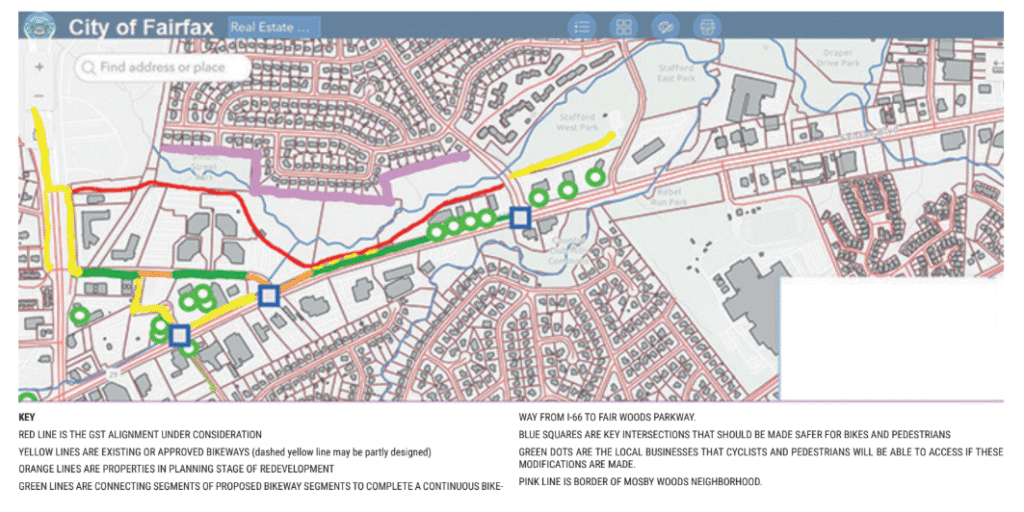
Here is a summary of the case against the through-the-woods GST:
- The GST is an expensive transportation project (over $21.5M for 1.7 miles). Any cost overruns will be out of taxpayers’ pockets. The city already has too many expensive-to-build and expensive-to-maintain projects. Very few have been vetted by the community in any substantive way. Contrary views have been ignored.
- It is redundant and unnecessary because the city has already committed to making Fairfax Boulevard and Eaton Place safer for bicyclists and walkers by providing safe passage between Route 123 and the Wilcoxon trailhead (on the south side of Fairfax Boulevard east of Harley Davidson).
- It includes five bridges, retaining walls, and 380 feet of boardwalk and major re-grading, requiring heavy construction activity in the area for two years or more. This is in addition to the Stafford stream restoration project nearby.
- It will destroy several acres of woodlands in the green buffer that separates Mosby Woods from Fairfax Boulevard.
- It will remove at least 600 mature trees, countless smaller trees and saplings, shrubs, and flowering plants, and, when the bulldozers start rolling, destroy the roots of many other mature trees.
Here are the benefits and features of the alternative design concept of a shared-use path along Eaton Place and Fairfax Boulevard:
- It connects bicyclists from the new I-66 bike trail on Route 123 to the Wilcoxon Trail near the Fairfax Circle, thus meeting the purpose of the GST grant, without destroying the woods wildlife habitats.
- It saves taxpayers dollars by eliminating the through-the-woods route that duplicates the city’s ongoing, planned, and approved transportation projects that aim to make Fairfax Blvd safer for pedestrians and cyclists.
- It connects cyclists directly to local businesses on Fairfax Blvd instead of bypassing businesses as did the through-the-woods design.
- It minimizes year-over-year operations and maintenance (O&M) costs because it uses existing and improved infrastructure instead of the additional O&M costs for through-the-woods asphalt trails, boardwalks, and retaining walls.
- It makes Eaton Place and Fairfax Blvd safer for cyclists who commute to work.
- It is a well-lit and patrolled route as opposed to the through-the-woods route.
- It improves pedestrian safety along more of Fairfax Blvd with safer crossings and buffered sidewalks than the through-the-woods design.
- It preserves our precious and scarce forests and wetlands and wildlife habitats.
- It connects to bikeable segments that are already in place.
- It enables the “Tree City” to demonstrate good stewardship of our dwindling green spaces by making the streets safe for people and by working to support vibrant, walkable communities – an objective in all versions of the Comprehensive Plans and other documents.
So, the question is: Will the City Council be responsible and explore ways to build the safe alternative instead of the expensive-to-build and expensive-to maintain through-the-woods trail?
We will see.

